Market Scenario
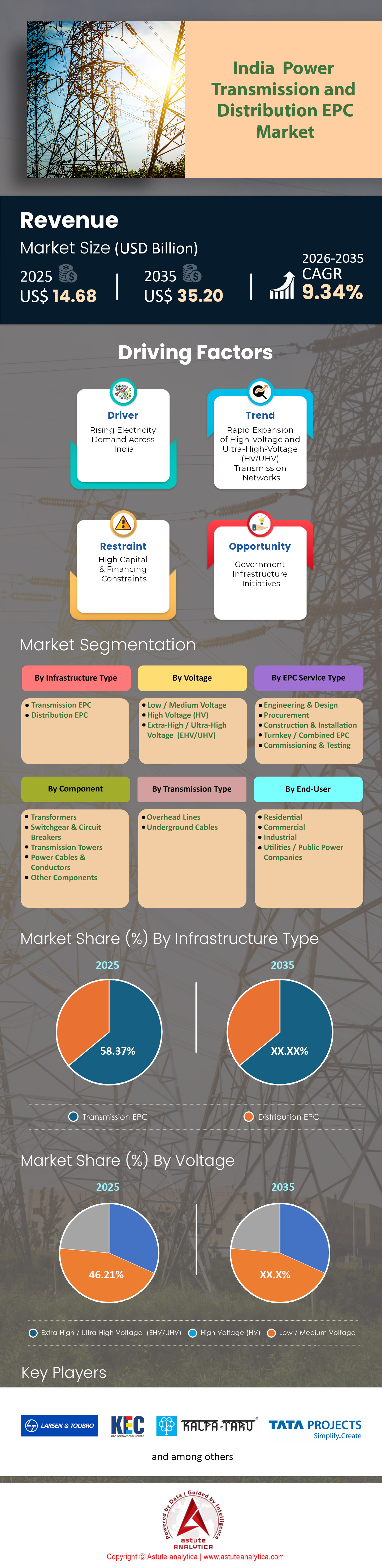
India power transmission and distribution EPC market size was valued at USD 14.68 billion in 2025 and is projected to hit the market valuation of USD 35.20 billion by 2035 at a CAGR of 9.34% during the forecast period 2026–2035.
Key Findings
- By Infrastructure type, Transmission EPC capture over 58.37% market share.
- By Voltage, Extra-High / Ultra-High Voltage (EHV/UHV) control the highest 46.21% market share.
- By Service Type, Construction & Installation service accounted for nearly 39.27% market share.
- By component, Power Cables & Conductors held around 26.33% share of India power transmission and distribution EPC market.
- By transmission type, Overhead Lines controlled over 81.67% market share.
- By End Users, utilities/public power companies captured 60.70% share of the India market.
- West India is the key contributor to India power transmission and distribution EPC market. It contributed over 31.61% revenue to the market in 2025.
Can India's Grid Infrastructure Handle the 500 GW Renewable Energy Target by 2030?
The India Power Transmission and Distribution EPC market has transcended its developmental phase to become one of the most robust and heavily capitalized infrastructure segments in the Asia-Pacific region. It is no longer just about basic electrification. The market is now a sophisticated engine driving the world's third-largest electricity consumer. As of early 2026, the sector is well-established, underpinned by a National Electricity Plan that targets a massive network expansion to 6.48 lakh circuit kilometers (ckm) by 2032.
The maturity of the market is evident in its execution velocity; in 2025 alone, the Ministry of Power successfully added 6,511 ckm of new transmission lines and boosted transformation capacity by a staggering 1,00,368 MVA. This scale of deployment indicates a market that is not only established but is operating at peak industrial efficiency to handle bidirectional power flows and complex grid dynamics.
To Get more Insights, Request A Free Sample
How are Recent Developments and The "Triple Transition" Fueling India Market Growth?
A "Triple Transition"—comprising generation, consumption, and network shifts—is currently adding explosive fuel to the India Power Transmission and Distribution EPC market. The most significant recent development is the strategic shift toward High-Voltage Direct Current (HVDC) technology to minimize losses over long distances. For instance, the approval of the Ladakh-Kaithal HVDC project, with an investment of Rs 20,773 crore, signals a move toward high-tech, high-value EPC contracts. Furthermore, the integration of cross-border trade has opened new revenue frontiers.
With exports to Bhutan reaching USD 96.9 million in November 2025 and new pacts to export 10,000 MW to Nepal, the grid is evolving into a regional hub. These developments, combined with the digitalization of the grid under the Revamped Distribution Sector Scheme (RDSS), are creating a multi-layered demand structure that goes beyond simple tower erection.
Is the Rapid Rollout of Renewable Infrastructure Creating a Logistical Bottleneck or an Opportunity?
The aggressive deployment of renewable energy such as solar power plants and wind energy is the primary catalyst reshaping the India Power Transmission and Distribution EPC market. The geographic disconnect between generation centers (like solar parks in deserts) and consumption hubs has necessitated the Green Energy Corridor (GEC) initiative.
To evacuate 280 GW of variable renewable energy, the government has outlined a requirement for 335 GW of Inter-State Transmission System (ISTS) capacity by 2030. This push is directly translating into EPC contracts; the GEC Phase-II alone aims to add 10,750 ckm of intra-state lines. Consequently, transmission planning now includes storage, evidenced by the 12 GWh Battery Energy Storage System (BESS) component in Ladakh. This rapid renewable rollout is not creating bottlenecks but rather a consistent pipeline of "Storage + Transmission" tenders, ensuring that EPC players have a roadmap of high-complexity work for the next decade.
How Fierce is the Competition and Which Players are dominating the Landscape?
Competition in the India Power Transmission and Distribution EPC market is intense, characterized by a healthy mix of public sector dominance and aggressive private sector expansion. The Tariff-Based Competitive Bidding (TBCB) mechanism has leveled the playing field, resulting in a tendering pipeline estimated at over Rs 90,000 crore in 2024.
Power Grid Corporation of India (PGCIL) remains the market behemoth, managing projects worth Rs 1,54,680 crore and setting a capital expenditure target of Rs 28,000 crore for FY26. Their dominance is driven by balance sheet strength and technical expertise in ultra-high voltage projects. However, private players are challenging this status quo.
Adani Energy Solutions has doubled its project pipeline to Rs 60,000 crore in 2025, leveraging its ability to execute complex projects like the Rs 25,000 crore Khavda-Bhuj link rapidly. In the pure-play EPC segment, Kalpataru Projects International Ltd (KPIL) held an all-time high order book of Rs 58,415 crore as of March 2024, while KEC International secured YTD inflows exceeding Rs 17,300 crore by late 2024. These players lead because they offer end-to-end solutions, from tower manufacturing to substation commissioning, which is crucial for meeting tight regulatory deadlines.
Which High-Growth Application Areas in India Power Transmission and Distribution EPC Market are Driving the Strongest Demand?
While utility-scale grid expansion remains the base, niche applications are driving the highest value growth in the India Power Transmission and Distribution EPC market. The explosive growth of data centers is a prime example; with capacity projected to hit 2,070 MW by the end of 2025, there is a surge in demand for high-reliability 220 kV and 400 kV GIS substations in urban clusters like Mumbai.
Additionally, the electrification of the railway network is generating consistent, volume-based demand. Tenders such as the Rs 269.89 crore transmission package in Kerala and various traction substation upgrades support a 2,342 GVA transformation capacity target for the railways. Furthermore, industrial corridor upgrades and smart city integrations are creating localized demand for underground cabling and automated distribution systems.
Is the India Power Transmission and Distribution EPC MarketReliant on Imports or is Domestic Manufacturing Self-Sufficient?
The India Power Transmission and Distribution EPC market has largely achieved self-reliance for traditional components like towers, conductors, and transformers, aligned with the "Make in India" initiative. Domestic manufacturing is robust enough that companies like KEC and Kalpataru act as global exporters.
However, for advanced technologies—specifically high-end smart meter semiconductors and specific HVDC converter components—there is still some reliance on global supply chains. To counter this, the government is tightening localization norms. A pivotal move was the Ministry of Power mandating 100% local content for smart meter software effective January 1, 2025. This ensures that while hardware might have imported elements, the intelligence and control layers remain indigenous, reducing geopolitical risks and fostering a local tech-EPC ecosystem.
Where is the Demand Concentration Geographically Located Within the Country?
The demand for the India Power Transmission and Distribution EPC market is geographically concentrated in two distinct types of zones: renewable generation hubs and high-load consumption centers.
- Western India (Gujarat & Rajasthan): This is the epicenter of renewable evacuation. Projects like the Khavda renewable park have turned Gujarat into a hotspot, with sanctions for 1.67 crore smart meters and massive HVDC corridors originating here.
- Northern India (Ladakh & Himachal): The focus here is on hydro and strategic solar evacuation, exemplified by the massive Ladakh grid projects.
- Urban Metros (Mumbai, Delhi, Bangalore): These cities drive the demand for grid hardening and data center power. Mumbai alone had 475 MW of data center capacity under construction in 2025, driving substation EPC work.
- Eastern India (Bihar): Driven by the RDSS, Bihar leads in distribution upgrades with 82.3 lakh smart meters installed, showcasing how policy can create demand in traditionally lagging regions.
What Government Plans Are Set to Propel the Market to the Next Level?
The government has laid out a crystal-clear financial and regulatory roadmap to propel the India Power Transmission and Distribution EPC market forward. The central pillar is the National Electricity Plan, which envisages a total investment of Rs 9.15 lakh crore in the transmission sector by 2032. To support the financial viability of this expansion, the 2025-26 Union Budget allocated Rs 3.03 lakh crore for the RDSS outlay. Additionally, specific budgetary support, such as the Rs 6 billion boost for GEC Phase-II projects, ensures liquidity for state-level execution.
On the policy front, the revised Right of Way (RoW) guidelines, which increased land compensation to 200% of the land value, have effectively removed one of the biggest hurdles to project speed. These synchronized fiscal and policy interventions ensure that the market is set for a decade of sustained, high-velocity growth.
Segmental Analysis
By Infrastructure: Utility Scale Renewable Integration Driving Dominance of Transmission EPC in India Power Transmission and Distribution EPC Market
The dominance of Transmission EPC is irrefutably anchored by the massive capital expenditure required to integrate 500 GW of renewable energy by 2030. This segment controls the market as the Central Electricity Authority (CEA) prioritizes the "Inter-State Transmission System" (ISTS) to evacuate power from solar parks in Rajasthan and Gujarat to load centers. As of early 2026, the sector is witnessing an unprecedented construction cycle. Power Grid Corporation of India Limited (PGCIL), the central utility, revised its capex guidance significantly upwards to ₹23,000 crore for FY25 to meet these aggressive grid expansion targets.
Furthermore, the CEA’s National Electricity Plan (Transmission) targets the addition of 114,687 circuit kilometers (ckm) of lines by 2027, creating a massive pipeline for EPC contractors. This utility-scale push ensures Transmission EPC remains the primary revenue engine in the India power transmission and distribution EPC market.
By Service: Complex Tower Erection and Stringing Fuels Dominance of Construction & Installation (C&I) Services
Construction & Installation (C&I) services command a major share of the India power transmission and distribution EPC market because they encompass the most capital and labor-intensive phases of EPC contracts: foundation laying, tower erection, and conductor stringing. The dominance of this segment is validated by the sheer volume of physical infrastructure currently under execution.
Leading players like KEC International reported an all-time high order book of ₹33,398 crore as of March 31, 2025, with their T&D vertical—primarily construction-focused—accounting for 61% of unexecuted orders. The complexity of projects, such as traversing difficult terrains for the Green Energy Corridor Phase-II, drives up service margins. Additionally, KEC secured its largest-ever domestic T&D order worth ₹1,150 crore in December 2025, underscoring that physical execution capabilities remain the critical differentiator and revenue driver for contractors.
By Component: High Voltage Corridors Boost Demand for Advanced Power Cables & Conductors
Power Cables & Conductors hold a significant 26.33% market share of the India power transmission and distribution EPC market, driven by the critical need for High-Temperature Low Sag (HTLS) conductors to enhance grid and microgrid capacity without replacing existing towers. This segment's dominance is reinforced by the material intensity of the 765kV and 400kV lines currently being rolled out. Apar Industries, a market leader in this segment, reported a 17.5% volume growth in its conductor business in Q1 FY26 (April-June 2025), reflecting surging demand.
Further validating this dominance, Apar’s conductor division recorded a staggering order inflow of ₹2,114 crore in Q4 FY25 alone. As the grid expands to a projected 571,403 ckm by 2027, the physical requirement for millions of kilometers of aluminum and alloy conductors ensures this component segment remains the most valuable material procurement category in the India power transmission and distribution EPC market.
Customize This Report + Validate with an Expert
Access only the sections you need—region-specific, company-level, or by use-case.
Includes a free consultation with a domain expert to help guide your decision.
By Transmission: Cost Efficiency and Terrain Adaptability Secure Overhead Line’s Supremacy in the Market
Overhead lines control over 81.67% of the market simply because underground cabling is economically unviable for India's long-distance transmission requirements. Industry data indicates that undergrounding high-voltage lines (400kV and above) costs 3 to 20 times more than overhead alternatives, making overhead lines the only fiscal reality for connecting remote renewable zones to the national grid in the India power transmission and distribution EPC market.
The dominance is further proven by the CEA’s operational statistics, which show that nearly all of the 16,667 ckm transmission line addition target for FY25 consists of overhead infrastructure. While underground cables are growing in select urban pockets like Mumbai or Delhi, the vast geography of the Indian subcontinent necessitates overhead solutions to maintain tariff affordability, solidifying its overwhelming market share.
To Understand More About this Research: Request A Free Sample
Country Analysis
West India Dominates with 31.61% Market Share Driven by Khavda and Mumbai Corridors
Gujarat and Maharashtra are the primary engines propelling West India to the forefront of the India power transmission and distribution EPC market. The region’s dominance is anchored by the massive evacuation infrastructure required for the 30 GW Khavda Renewable Energy Park in Gujarat, the world's largest renewable energy zone. In FY25, approval for Phase-III of the Khavda transmission scheme alone injected ₹24,819 crore into the EPC pipeline, creating an unprecedented construction boom. Furthermore, Gujarat solidified its status as a renewable powerhouse by crossing 28 GW of installed renewable capacity in 2025, necessitating extensive Green Energy Corridor expansions that heavily favor local EPC contractors.
In Maharashtra, the market is driven by complex High Voltage Direct Current (HVDC) projects designed to secure Mumbai’s power reliability. The ongoing execution of the 80 km Kudus-Aarey HVDC link, a critical project by Adani Energy Solutions, involves a distinct capex outlay of roughly ₹7,000 crore, with significant milestones achieved in late 2025. Data from Grid-India indicates that the Western Region’s total inter-regional transfer capacity expanded to 128,450 MW by January 2026 to support industrial load centers. Additionally, private sector intensity is highest here, with Adani Energy Solutions reporting that 60% of its transmission assets under operation or construction are located in this high-growth western belt.
Corporate Announcements by Companies Active in India Power Transmission and Distribution EPC Market
In a defining market event on January 21, 2025, Adani Energy Solutions Limited (AESL) announced securing the Bhadla-Fatehpur HVDC project valued at ₹25,000 crore. This is the largest-ever transmission order won by the company. The project, awarded via Tariff-Based Competitive Bidding (TBCB), involves constructing a 6,000 MW HVDC system to evacuate renewable energy from Rajasthan’s solar zones to the national grid.
On September 11, 2025, Kalpataru Projects International Limited (KPIL) notified the stock exchanges of new order wins totaling ₹2,720 crore. These contracts span the T&D and Buildings & Factories (B&F) sectors, significantly bolstering its FY26 order book. This win reinforces the dominance of large EPC players in securing complex grid modernization contracts.
On February 17, 2025, Sterlite Power announced the successful commissioning of the Nangalbibra-Bongaigaon 400kV D/C transmission line. Executed through a Special Purpose Vehicle (SPV), this project is pivotal for the North-East region, enabling the transfer of over 1,000 MW of power from Assam to Meghalaya and strengthening the interstate transmission system (ISTS).
KEC International continued its aggressive expansion by securing orders worth ₹1,509 crore on July 30, 2025. The mandate includes a significant 400 kV transmission line project in India and strategic overhead line projects in the Americas, underscoring the company’s dual focus on domestic grid densification and international market capture.
On December 31, 2024, Power Grid Corporation of India Limited (PGCIL) completed the acquisition of Rajasthan IV 4A Power Transmission Limited. This SPV, acquired under the TBCB route, is tasked with evacuating power from the Rajasthan Renewable Energy Zone (REZ) Phase-IV, marking the start of a new capex cycle for the state utility.
Top Companies in the India Power Transmission and Distribution EPC Market
- Larsen & Toubro Limited
- KEC International Ltd .
- Kalpataru Projects International Ltd.
- Siemens Energy
- ABB Ltd .
- Megha Engineering & Infrastructures Ltd
- General Electric Company
- Techno Electric & Engineering Company Ltd
- Transrail Lighting Limited
- Sterlite Power
- Hyundai Engineering & Construction Co., Ltd.
- Schneider Electric
- Tata Projects Limited
- Other Prominent Players
Market Segmentation Overview
By Infrastructure Type
- Transmission EPC
- Distribution EPC
By Voltage
- Low / Medium Voltage
- High Voltage (HV)
- Extra-High / Ultra-High Voltage (EHV/UHV)
By EPC Service Type
- Engineering & Design
- Procurement
- Construction & Installation
- Turnkey / Combined EPC
- Commissioning & Testing
By Component
- Transformers
- Switchgear & Circuit Breakers
- Transmission Towers
- Power Cables & Conductors
- Other Components
By Transmission Type
- Overhead Lines
- Underground Cables
By End User
- Residential
- Commercial
- Industrial
- Utilities / Public Power Companies
FREQUENTLY ASKED QUESTIONS
The India Power Transmission and Distribution EPC market was valued at USD 14.68 billion in 2025. Driven by massive grid expansion targets, the market is projected to reach USD 35.20 billion by 2035, registering a robust CAGR of 9.34% during the forecast period 2026–2035.
The urgency to evacuate 280 GW of renewable energy by 2030 is generating massive demand. The government’s roadmap requires 335 GW of Inter-State Transmission System capacity, fueling initiatives like the Green Energy Corridor Phase-II, which aims to add 10,750 ckm of intra-state lines, ensuring a steady pipeline of utility-scale contracts.
Western India is the most lucrative region, contributing 31.61% of market revenue in 2025. Demand is anchored by Gujarat’s 30 GW Khavda Renewable Park and Maharashtra’s complex urban grid upgrades, including high-value HVDC projects in Mumbai.
HVDC is essential for minimizing losses during long-distance bulk power transfer. This shift is creating premium opportunities, exemplified by the approval of the Rs 20,773 crore Ladakh-Kaithal HVDC project, which requires specialized engineering for high-altitude, ±350kV infrastructure deployment.
The market is led by Power Grid Corporation (PGCIL), managing projects worth Rs 1,54,680 crore, and aggressive private players like Adani Energy Solutions, which boasts a Rs 60,000 crore pipeline. Pure-play EPC giants like Kalpataru Projects and KEC International also dominate with record-high order books.
The government has allocated Rs 3.03 lakh crore for the Revamped Distribution Sector Scheme (RDSS) and revised Right of Way (RoW) guidelines to offer 200% land compensation. These synchronized reforms have significantly reduced land acquisition bottlenecks and ensured financial liquidity for state-level projects.
LOOKING FOR COMPREHENSIVE MARKET KNOWLEDGE? ENGAGE OUR EXPERT SPECIALISTS.
SPEAK TO AN ANALYST
.svg)

 Schedule a Meeting

Features | Type of License | ||||
 Data Book | Single User |   Multi User |  Corporate | ||
| e-Access | ✓ | ✓ | ✓ | ✓ | |
User Sharing | 1 User Only | 1 User Only | Up to 7 Users | Unlimited User Access | |
⨉ | ⨉ | ⨉ | ✓ | ||
Free Customization | No Free Customization | Up To 30 hrs work | Up To 60 hrs work | Up To 80 hrs work | |
Deliverable |
| ⨉ | ✓ | ✓ | ✓ |
| ✓ | ⨉ | ✓ | ✓ | |
| ⨉ | ⨉ | ⨉ | ✓ | |
Analyst Support | 2-Months Analyst Support | 4-Months Analyst Support | 7-Months Analyst Support | One Year Analyst Support | |
Free Report update in next update cycle | ⨉ | ⨉ | ⨉ | ✓ | |
Free Industry Update (Within 180 days) | ⨉ | ⨉ | ⨉ | ✓ | |
Benefit | Up to 10% off on Post Purchase | Up to 20% off on Post Purchase | Up to 30% off on Post Purchase | Up to 40% off on Post Purchase | |